June 6, 1944  ·  Normandy, France

D-DAY

OPERATION OVERLORD

The Liberation of Western Europe

156,000 Allied Troops 5 Beaches 5,000+ Ships
Troops landing at Omaha Beach Omaha Beach
Eisenhower with 101st Airborne Ike & the 101st
Paratroopers boarding C-47 Before the Jump
Scroll
0+
Allied Troops Landed
0+
Ships & Craft
0
Aircraft Sorties
0+
American Paratroopers
0+
Allied Casualties Day 1
0
Confirmed Allied Dead

OPERATION
OVERLORD

Operation Overlord was the codename for the Allied invasion of Northwest Europe — the largest amphibious military operation in history. Conceived in 1943 at the Tehran Conference between Roosevelt, Churchill, and Stalin, it was entrusted to Supreme Allied Commander General Dwight D. Eisenhower, who would direct a combined force of American, British, Canadian, Free French, Polish, Norwegian, and Australian troops.

The invasion required deceiving Germany into believing the main blow would fall at Pas-de-Calais — 150 miles northeast. Operation Bodyguard and its centerpiece, Operation Fortitude, used a fictional army group under General Patton, fake radio traffic, and the Ghost Army's deceptions to fix German reserves in place. It worked: Hitler held the 15th Army at Pas-de-Calais for weeks after D-Day, convinced Normandy was a feint.

The assault unfolded in two phases: Operation Neptune (the naval and airborne landings) beginning at midnight June 5–6, and the five simultaneous beach assaults at H-Hour, 06:30 on June 6, 1944. By day's end, the Atlantic Wall had been breached.

EISENHOWER'S PERSONAL NOTE — PREPARED IN CASE OF FAILURE
"Our landings in the Cherbourg-Havre area have failed to gain a satisfactory foothold and I have withdrawn the troops. My decision to attack at this time and place was based upon the best information available. The troops, the air and the Navy did all that Bravery and devotion to duty could do. If any blame or fault attaches to the attempt it is mine alone."
— Written June 5, 1944. Never sent. Discovered in his wallet years later.
Overlord planning map
Click to enlarge · US Army / Public Domain
Eisenhower Order of the Day
Eisenhower's Order of the Day — June 6, 1944

THE BEACHES

A 50-mile stretch of the Normandy coast was divided into five assault sectors, each assigned a code name and a specific Allied division. From west to east: Utah, Omaha (American), Gold, Juno (Canadian), and Sword (British).

Utah Beach landing
UTAH
American H-Hour: 06:30
4th Infantry Division

Utah was the westernmost and most successful American landing. The 4th Infantry Division came ashore 2,000 yards south of their intended sector — accidentally landing opposite lighter German defenses. Brigadier General Theodore Roosevelt Jr., the only general officer in the first wave, surveyed the wrong beach and made one of the war's great decisions: "We'll start the war from right here."

23,000
Troops Landed
~197
Casualties
Omaha Beach landing
OMAHA
American H-Hour: 06:30
1st & 29th Infantry Divisions

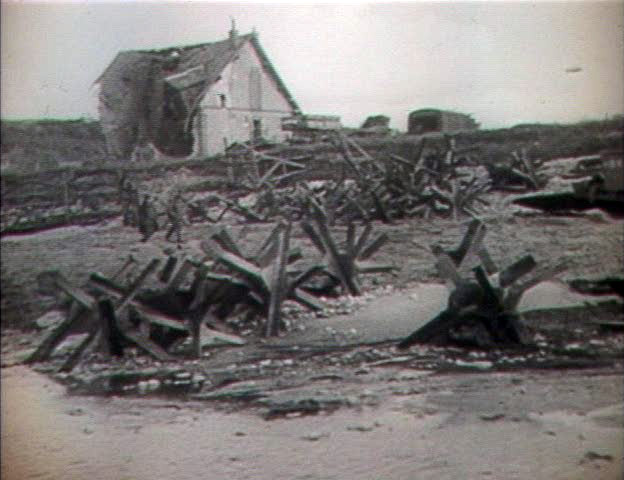
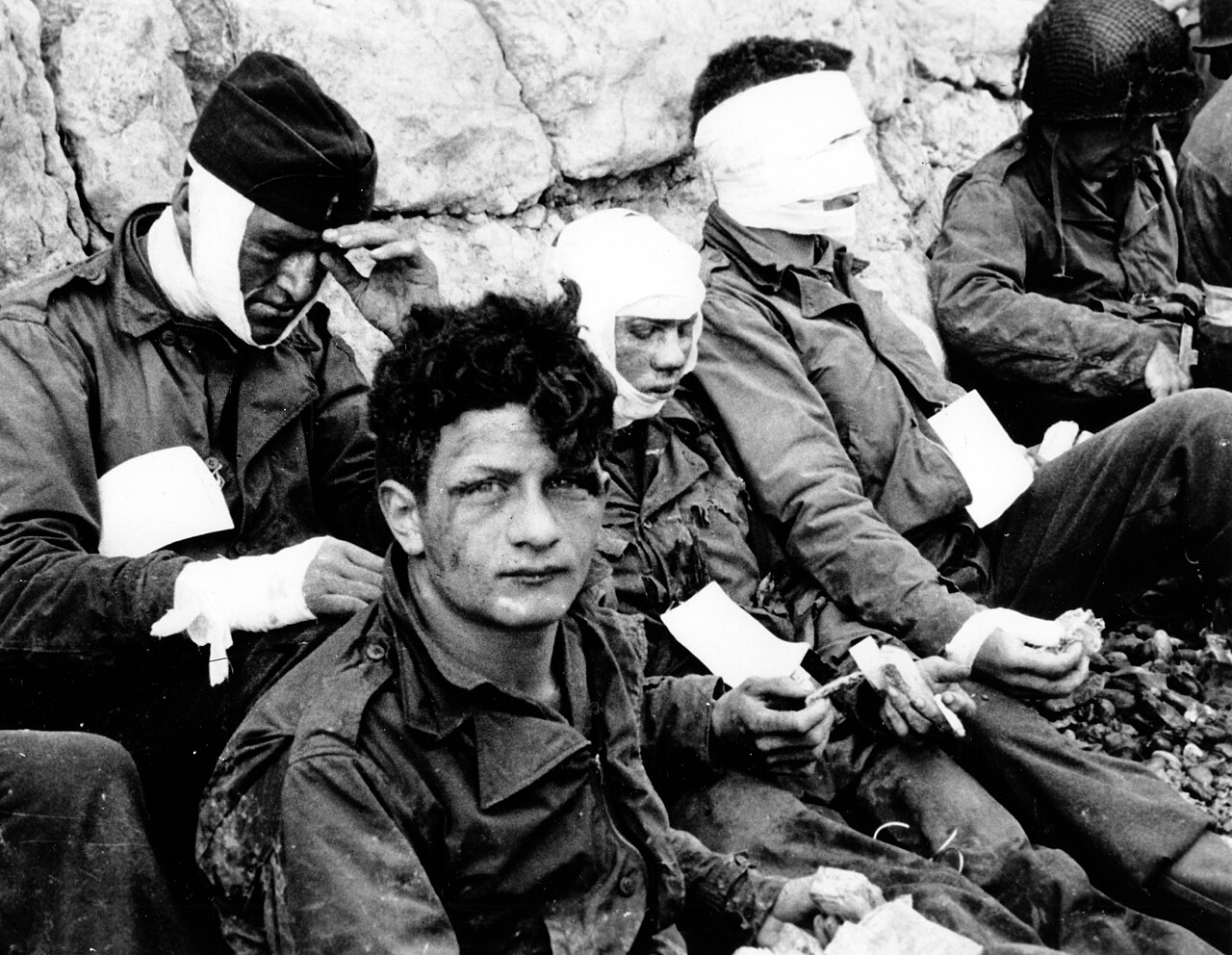
Omaha was catastrophe. The German 352nd Infantry Division held the heights with interlocking fields of fire. Most of the DD (swimming) tanks sank before reaching shore. Company A of the 116th Infantry Regiment was nearly annihilated at the waterline. For hours, men crouched behind bodies and obstacles as the tide rose. Survival depended on small groups of soldiers — sergeants and junior officers — who began climbing the bluffs under fire. General Omar Bradley considered abandoning the beach entirely.

34,000
Troops Landed
~2,000
Casualties
Gold Beach landing
GOLD
British H-Hour: 07:25
50th Northumbrian Infantry Division

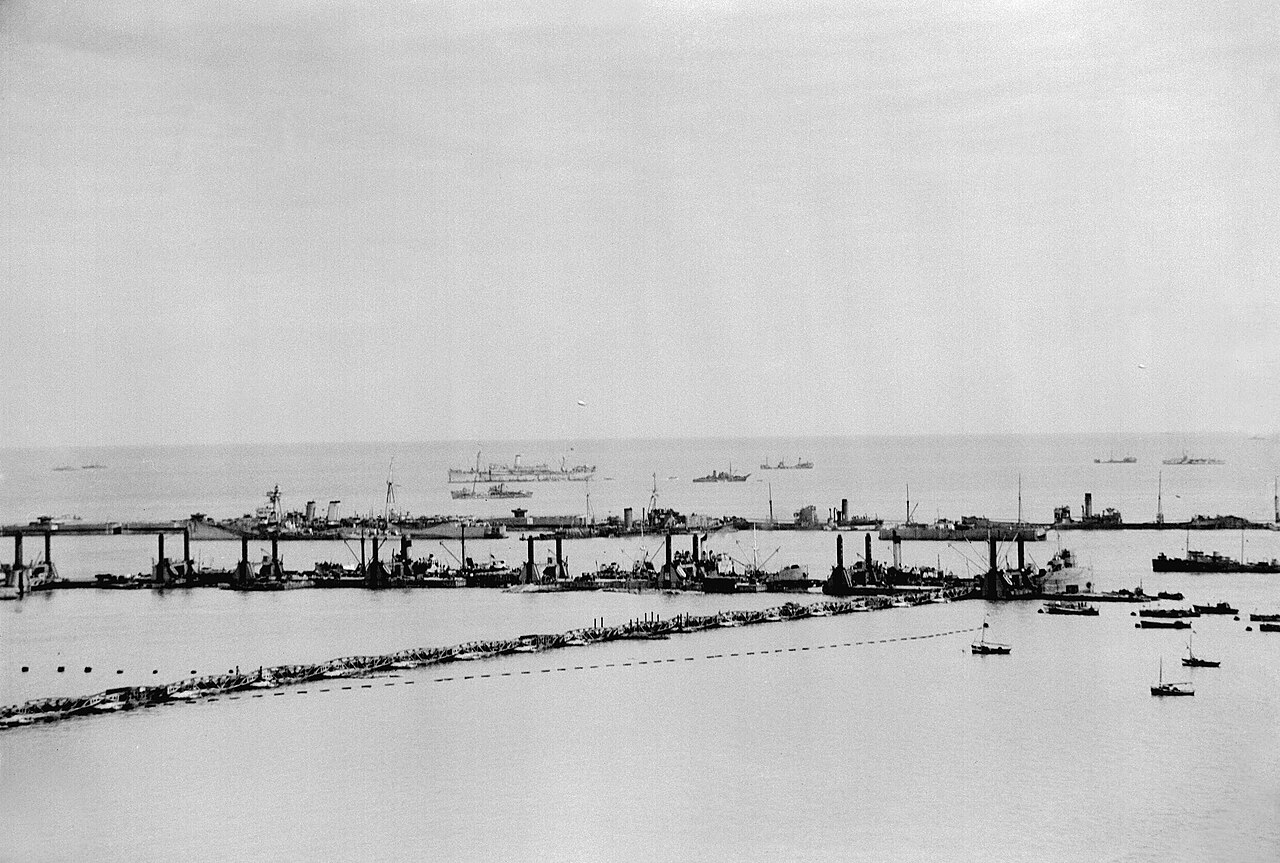
The British 50th Division landed at Gold and advanced further inland than any other beach on D-Day. They seized the town of Arromanches — critically, this became the site of Mulberry B, the prefabricated artificial harbour that would eventually land 2.5 million men, 500,000 vehicles, and 4 million tons of supplies. The 47th Royal Marine Commando pushed to link with the Americans at Omaha.

25,000
Troops Landed
~400
Casualties
Juno Beach landing
JUNO
Canadian H-Hour: 07:35
3rd Canadian Infantry Division

Canada's D-Day. The 3rd Canadian Division suffered heavy casualties at the seawall — the Regina Rifle Regiment, Royal Winnipeg Rifles, and Queen's Own Rifles took punishing fire from fortified houses and pillboxes. But the Canadians pushed harder and deeper inland than any other Allied division, reaching within three miles of Caen by nightfall — the furthest advance of any beach force on D-Day. 21,500 Canadians landed.

21,500
Troops Landed
~1,200
Casualties
Sword Beach landing
SWORD
British H-Hour: 07:25
3rd British Infantry Division

Sword was the easternmost beach, closest to Caen. Lord Lovat's 1st Special Service Brigade landed with Piper Bill Millin playing Blue Bonnets Over the Border on the beach under fire — told German snipers didn't shoot him because they thought he was insane. French Commandos under Commandant Kieffer stormed the Ouistreham casino strongpoint. By afternoon, Lovat's men linked up with the 6th Airborne at Pegasus Bridge — the day's most iconic meeting of forces.

29,000
Troops Landed
~630
Casualties
Pointe du Hoc cliffs
POINTE DU HOC
Rangers scaled 100-foot cliffs under fire · June 6, 1944

THE ROAD TO VICTORY

The Great War & Its Aftermath 1916 – 1933
Feb 21 – Dec 18, 1916
Battle of Verdun — The Meat Grinder
The longest battle of the First World War. Germany's Chief of Staff Falkenhayn designs it deliberately to "bleed France white" at a fortified salient both sides consider sacred. Ten months of industrial slaughter on a nine-mile front: 70 million artillery shells fired, entire villages obliterated from the map. France holds — at a cost of 161,000 dead and 216,000 wounded. Germany suffers 143,000 dead. The war continues. A generation of men is hollowed out. The trauma of Verdun will haunt French military doctrine for twenty years — producing the Maginot Line mentality that makes 1940's German blitzkrieg devastating.
WWI · France
Jul 1 – Nov 18, 1916
Battle of the Somme — 57,470 British Casualties in One Day
The first day of the Somme — July 1, 1916 — remains the bloodiest single day in British military history. Soldiers walk into uncut wire and unsilenced machine guns that the week-long artillery barrage failed to destroy. By nightfall: 19,240 British dead, 38,230 wounded. The battle grinds on until November. Total British and Commonwealth dead: 95,675. A Corporal named Adolf Hitler, serving with the 16th Bavarian Reserve Infantry, is wounded in the thigh during the Somme. He survives.
WWI · Western Front
November 11, 1918
Armistice — The War Ends, the Seeds Are Planted
At 11:00 AM on the 11th day of the 11th month, the guns fall silent. Germany surrenders. The Kaiser abdicates. Four empires collapse. Ten million soldiers are dead. The terms are humiliating for Germany but the German Army is not destroyed on German soil — a fact that will be exploited. The "stab-in-the-back" myth takes hold: that Germany was betrayed from within by Jews and socialists, not defeated in the field. Adolf Hitler, recovering from a mustard gas attack in a Pomeranian hospital, weeps when he hears the news. He later calls it the moment he decided to enter politics.
WWI Ends
June 28, 1919
Treaty of Versailles — The Peace That Breeds the Next War
Germany signs. War guilt clause (Article 231) assigns full blame for the war to Germany. Reparations are set at 132 billion gold marks. Alsace-Lorraine goes to France. The Rhineland is demilitarized. The German military is capped at 100,000 men. John Maynard Keynes, attending as a British delegate, resigns in protest, writing The Economic Consequences of the Peace — predicting the settlement will produce another European war within twenty years. He is correct to within three months.
Versailles
1923 – 1933
Germany Collapses — Hitler Rises
Hyperinflation wipes out the German middle class (1923). The Great Depression destroys what recovery had been made (1929). Six million unemployed by 1932. The Nazi Party grows from a fringe movement to the largest party in the Reichstag. Hitler delivers speeches to crowds of hundreds of thousands. On January 30, 1933, President Hindenburg appoints Adolf Hitler Chancellor of Germany — a calculated political gamble by the old conservative establishment that they can control him. They cannot.
Nazi Rise
Road to World War 1933 – 1939
1933 – 1936
Hitler Consolidates Power — The Atlantic Wall Begins
The Reichstag Fire grants emergency powers. The Enabling Act makes Hitler a dictator. The Night of the Long Knives eliminates internal rivals. Germany secretly begins rearming in violation of Versailles. In 1936, Germany remilitarizes the Rhineland — France and Britain do nothing. The same year, Hitler and Mussolini form the Axis. The Wehrmacht grows from 100,000 to over a million men. Germany begins fortifying its western coast — the early stages of what will become the Atlantic Wall that Allied soldiers will assault on June 6, 1944.
Third Reich
September 1 – 3, 1939
Germany Invades Poland — World War II Begins
At 04:45 AM, Wehrmacht forces cross into Poland on three fronts. A staged "Polish attack" on a German radio station — Operation Himmler — provides the pretext. Britain and France, having guaranteed Polish sovereignty, declare war on Germany two days later. The Soviet Union invades from the east on September 17 under the Molotov-Ribbentrop Pact. Poland falls in five weeks. Sixty million people will die before this war ends. America is not yet in it.
WWII Begins
May 10 – Jun 25, 1940
Fall of France — The Catastrophe
Germany bypasses the Maginot Line through the Ardennes — terrain the French generals considered impassable for armor. In six weeks, France is defeated. 338,000 Allied soldiers are evacuated at Dunkirk in a desperate miracle of small boats. Paris falls on June 14. France signs an armistice in the same railway carriage at Compiègne where Germany surrendered in 1918 — Hitler personally choreographs the humiliation. Britain now stands alone. General Charles de Gaulle broadcasts from London: "France has lost a battle, but France has not lost the war."
Fall of France
Jul – Oct 1940
Battle of Britain — The RAF Holds
Hitler orders Operation Sea Lion: the invasion of Britain. First, the Luftwaffe must destroy the RAF. For four months, British and German pilots fight daily over the English Channel and southern England. The RAF — outnumbered but fighting over home territory — inflicts unsustainable losses on the Luftwaffe. Churchill: "Never in the field of human conflict was so much owed by so many to so few." Hitler postpones Sea Lion indefinitely. Britain survives. The island becomes the base from which, four years later, Operation Overlord will be launched.
Britain Holds
December 7, 1941
Pearl Harbor — America Enters the War
At 07:48 AM Hawaiian time, 353 Japanese aircraft strike the U.S. naval base at Pearl Harbor in a surprise attack. Eight battleships are damaged or sunk. 2,403 Americans are killed. The next day, Congress declares war on Japan. On December 11, Germany and Italy declare war on the United States — a strategic catastrophe Hitler will come to regret. America's industrial capacity, population, and geography will prove decisive. FDR calls it "a date which will live in infamy." The sleeping giant is awake.
America at War
Building Toward Overlord 1942 – June 5, 1944
January 1943
Casablanca Conference — The Decision for Overlord
Roosevelt and Churchill meet in Casablanca. They announce the policy of "unconditional surrender" — no negotiated peace with Nazi Germany. The Allied strategy is debated: Churchill favors attacking through the "soft underbelly" of the Mediterranean; American generals push for a cross-Channel invasion as the decisive blow. They agree on Sicily next, and commit to planning the eventual assault on northwest France. The name chosen: Operation Overlord. A supreme commander will be needed. Both men assume it will be George C. Marshall.
Allied Strategy
August 19, 1942
Dieppe Raid — The Costly Lesson
Operation Jubilee: 6,086 Allied troops, mostly Canadian, assault the French port of Dieppe. In nine hours of disaster, 3,623 are killed, wounded, or captured. The frontal assault on a defended port proves catastrophically costly. The lessons are brutal and invaluable: ports cannot be taken from the sea; a portable harbor (Mulberry) must be brought along; naval gunfire support must be continuous; armor must be able to land directly on the beach. Every lesson from Dieppe is baked into the planning of Operation Overlord. Two thousand Canadians die so that D-Day can succeed.
Dieppe · Costly Lesson
December 24, 1943
Eisenhower Named Supreme Commander
In a surprise decision, Roosevelt names Dwight D. Eisenhower — not Marshall — as Supreme Commander of the Allied Expeditionary Force (SHAEF). Roosevelt tells Marshall: "I could not sleep at night with you out of the country." Eisenhower inherits command of the most complex military operation in history. His deputy is Air Chief Marshal Arthur Tedder. Bernard Montgomery commands ground forces for the assault phase. The team assembles in England. Eisenhower's headquarters: Bushy Park, near London.
Command Appointed
Early 1944
Operation Fortitude — The Greatest Deception
The Ghost Army's parent operation. SHAEF creates FUSAG — the fictional First United States Army Group — under the notional command of General George Patton, whom the Germans believe is the Allies' best commander and therefore most likely to lead the main invasion. Double agents, fake radio traffic, inflatable tanks and aircraft in southeast England, and a carefully constructed deception build a phantom army of 150,000 men opposite Pas-de-Calais. Hitler and his generals become convinced the Normandy landings are a feint. German Panzer reserves are held back for weeks waiting for the "real" invasion. The deception works beyond anyone's dreams.
Operation Fortitude
April 28, 1944
Exercise Tiger Disaster — 749 Americans Killed in Training
A rehearsal for Utah Beach in Lyme Bay, Devon, goes catastrophically wrong when nine German E-boats slip through a gap in the Royal Navy escort screen and torpedo two LSTs. LST-507 and LST-531 are sunk. A third, LST-289, is badly damaged. 749 American soldiers and sailors die — more than will die on Utah Beach on D-Day itself. The disaster is classified to protect Overlord security. Families are notified only that their sons died "in the line of duty." The truth will not be officially acknowledged for forty years.
Exercise Tiger
May 1944
England Becomes One Giant Base
Two million American servicemen are now in Britain — one for every ten British civilians. 5,000 ships are assembled in ports from Bristol to the Thames. The southern coast is sealed off. Civilians are barred from coastal areas. Under Eisenhower's command, 12,000 aircraft, 50,000 vehicles, 13 million tons of supplies, and 1,700 locomotives have crossed the Atlantic. American pilots fly systematic attacks destroying rail yards, bridges, and airfields across northern France — the Transportation Plan — to isolate the Normandy battlefield before a single soldier lands. Germany's logistics in France begin to collapse before D-Day begins.
Buildup · England
June 1, 1944
BBC Broadcasts the Signal — French Resistance Activates
The first line of Paul Verlaine's poem Chanson d'Automne"Les sanglots longs des violons de l'automne" — is broadcast on the BBC French service, alerting the French Resistance that the invasion is coming within two weeks. German intelligence intercepts the signal but High Command dismisses the warning. The second line, broadcast June 5th, triggers Resistance sabotage operations across France: rail lines cut, telephone cables severed, German convoys ambushed. At least 950 acts of sabotage are confirmed before dawn on June 6.
French Resistance
June 3 – 4, 1944
D-Day Postponed — The Storm
D-Day is set for June 5. A Force 5 storm tears across the English Channel. Meteorologist Group Captain James Stagg briefs Eisenhower at Southwick House on June 4: the weather is impossible. Eisenhower postpones 24 hours. The entire 5,000-ship armada must turn back or hold. Several ships at sea cannot receive the recall signal in time. One unit returns to port days late. Rommel, believing no invasion is possible in such weather, travels to Germany to celebrate his wife's birthday and visit Hitler. He will not return until the beaches are already burning.
D-Day Postponed
June 5, 1944 — 21:30 HRS
Eisenhower's Order of the Day — "Full Victory Nothing Else"
Stagg reports a narrow 36-hour weather window. Eisenhower pauses for thirty seconds. "O.K.," he says quietly. "We'll go." He walks among the paratroopers of the 101st Airborne at Greenham Common, talking to soldiers, looking each one in the face. He has already written a message for if the invasion fails: "Our landings… have failed… The troops, the air and the Navy did all that bravery and devotion to duty could do. If any blame or fault attaches to the attempt it is mine alone." He puts the note in his wallet. The armada is already at sea.
Decision to Go
D-Day — Hour by Hour June 6, 1944
00:16 HRS
Pegasus Bridge — First Liberation
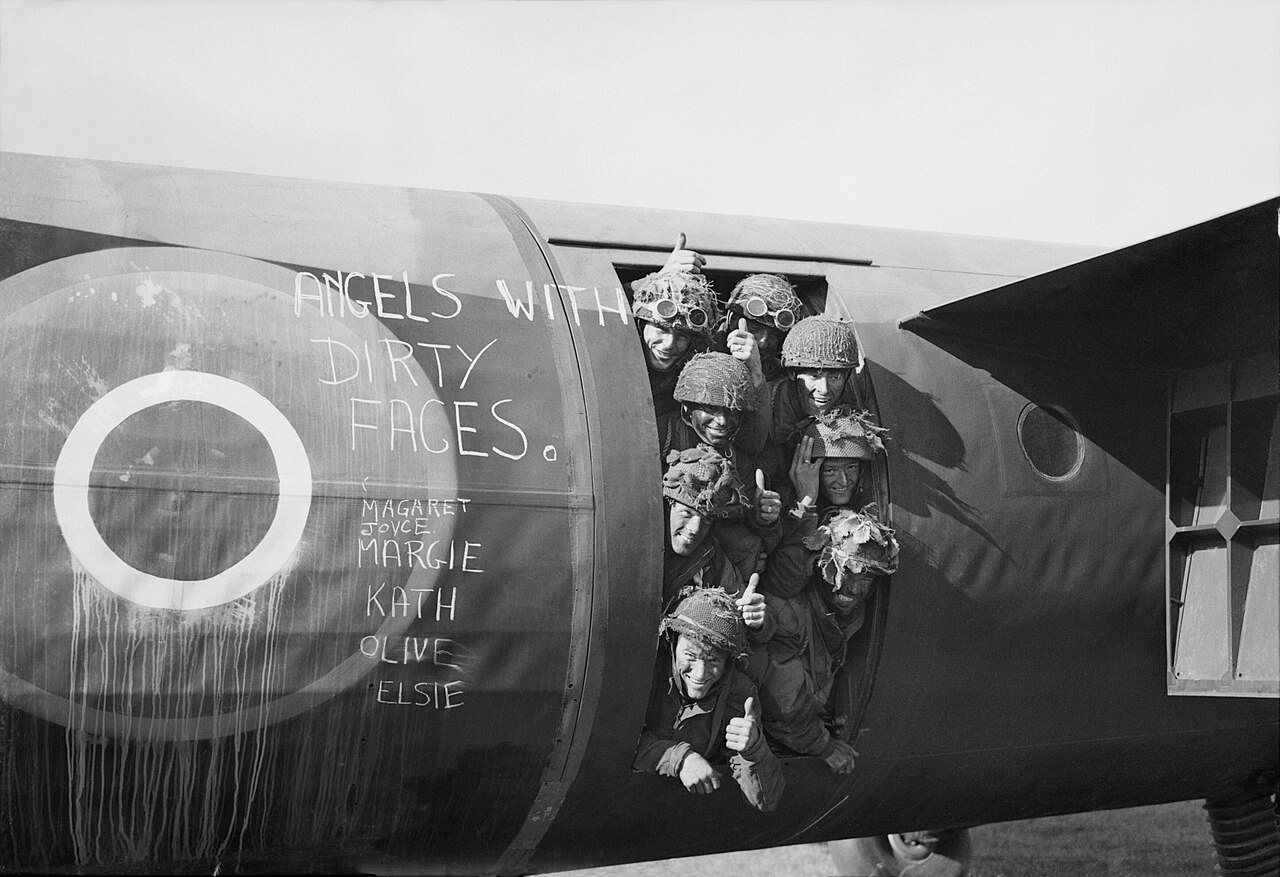
Six Horsa gliders carrying D Company, 2nd Battalion Oxfordshire and Buckinghamshire Light Infantry, land within yards of the Orne canal bridge. Major John Howard's men rush the bridge in a 10-minute assault. Lieutenant Den Brotheridge is the first Allied soldier killed in action on D-Day. The bridge is taken intact at 00:21. Corporal Wally Parr shouts "Ham and Jam" — the success signal. The first French soil of the invasion has been liberated.
British Airborne
00:16 HRS
Pathfinders Drop
American pathfinder teams parachute into the Cotentin Peninsula to mark drop zones for the 82nd and 101st Airborne. Scattered by cloud cover and flak, many land miles off target. Their Eureka beacons will guide — imperfectly — the main drop to follow.
US Airborne
01:30 HRS
Operation Albany — 101st Airborne Mass Drop
13,000 paratroopers of the 101st Airborne Division ("Screaming Eagles") jump from 821 C-47s over the Cotentin Peninsula. Heavy flak and cloud scatter the drop — some men drown in flooded marshes under the weight of their equipment. Small groups coalesce in the dark and begin fighting toward the causeways behind Utah Beach and the crossroads at Saint-Côme-du-Mont.
Parachute drop
US Airborne
01:30 HRS
Operation Boston — 82nd Airborne
The 82nd Airborne ("All-American"), 6,600 men, jumps to seize Sainte-Mère-Église and secure Merderet River crossings. Private John Steele's parachute snags on the church steeple; he hangs there for two hours, playing dead. The 82nd will hold the western flank against repeated German armored counterattacks.
Airborne soldiers
US Airborne
03:00 HRS
British 6th Airborne — Eastern Flank Secured
9th Parachute Battalion destroys the Merville Battery — four 100mm guns zeroed on Sword Beach — in a costly assault with only 150 of 600 men reaching the objective. Bridges over the Dives River are blown. The flank that would stop German armor sweeping into the beaches from the east is now held.
British Airborne
05:50 HRS
Naval Bombardment Opens
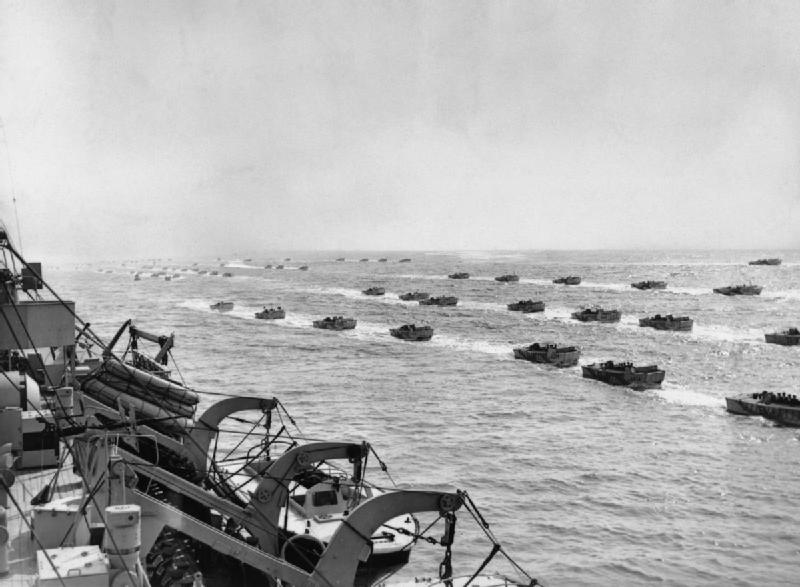
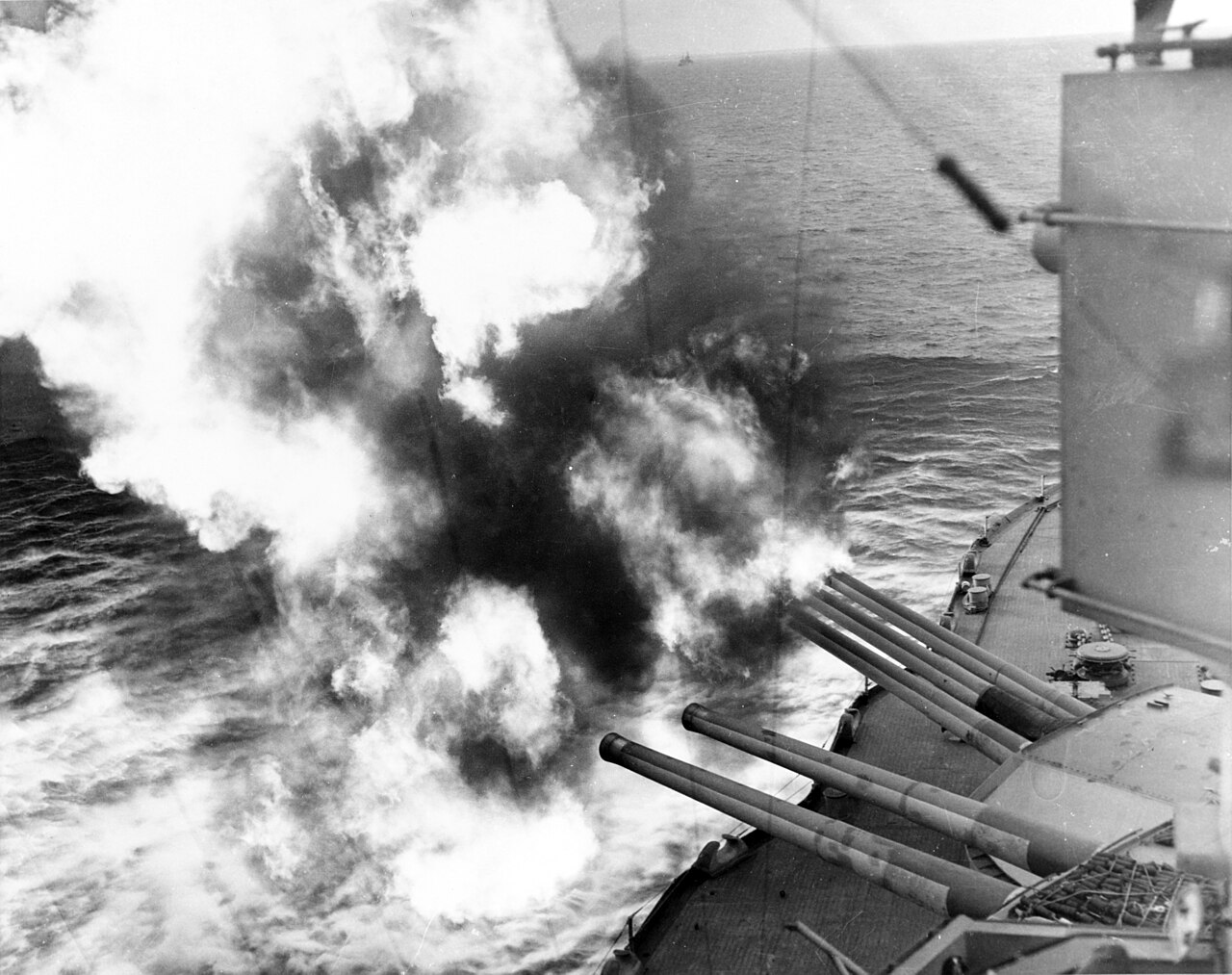
Six battleships, 22 cruisers, 93 destroyers open fire on German coastal defenses. The sound is heard in southern England. Over 1,200 bombers drop 13,000 bombs — but cloud cover over Omaha causes most bombs to fall miles inland, leaving German fortifications untouched. The men of Omaha will pay for it.
Naval/Air
06:30 HRS — H-HOUR
The Beaches Open — Americans Hit Utah & Omaha
Ramps drop. Men wade into the surf. At Utah, the 4th Infantry lands 2,000 yards off course — opposite lighter defenses. Brigadier General Theodore Roosevelt Jr. makes the instant decision: "We'll start the war from right here." At Omaha, Company A of the 116th Infantry loses nearly every man in the water and at the shingle. 27 of 29 DD tanks on one sector sink. For the men of Omaha, the morning is a nightmare that history will not forget.
Omaha Beach aerial
H-HOUR
07:10 HRS
Rangers Scale Pointe du Hoc
2nd and 5th Ranger Battalions assault Pointe du Hoc's 100-foot cliffs under fire. Colonel James Earl Rudder leads the climb. The Rangers summit to find the guns removed — locate them in an orchard, destroy them with thermite. They hold the point for two days: 225 men in, 90 still fighting at the end.
Rangers
07:25–07:45 HRS
British & Canadian Beaches Open — Gold, Juno, Sword
Gold: 50th Division lands with Hobart's Funnies — flail tanks, AVRE bridge-layers — dramatically reducing casualties. Juno: Canadian 3rd Division sustains 50% casualties in the first wave before breaking through. French Commando Kieffer's men land at Sword alongside Piper Bill Millin. Lord Lovat walks the beach without a helmet.
Piper Bill Millin
British / Canadian
09:00 HRS
Omaha Breaks
Colonel George Taylor: "Two kinds of people are staying on this beach — the dead and those who are going to die." Small groups begin moving. Staff Sergeant William Stivison. Lieutenant John Spalding. Sergeant Phil Streczyk. They find gaps in the wire, climb the draws, attack from behind. Destroyers drive to within 800 yards of shore to provide direct fire. By 09:00 the first men are on top of the bluffs.
Soldiers at Omaha Beach
Breakthrough
13:00 HRS
Sainte-Mère-Église Liberated
The 82nd Airborne's 505th PIR secures Sainte-Mère-Église — the first French town liberated by American forces. Paratroopers raise the flag from the town square. John Steele is cut down from the steeple. The church clock is stopped.
Sainte-Mère-Église
Liberation
16:00 HRS
Lovat Meets the Airborne — Pegasus Bridge Linked
Lord Lovat's commandos, marching four miles from Sword Beach, link up with the British 6th Airborne at Pegasus Bridge — 2 minutes 30 seconds late, for which Lovat famously apologized. Piper Bill Millin plays them across the bridge. The eastern flank is continuous. It is one of D-Day's most human moments.
Pegasus Bridge
Allied Link-Up
24:00 HRS
End of D-Day — The Foothold Holds
156,115 Allied troops have crossed the Channel. Five beachheads exist — tenuous, not yet linked — but they exist. Allied casualties: over 10,000, with 4,414 confirmed dead. German casualties: estimated 4,000–9,000. Hitler, convinced by Fortitude this is a feint, refuses to release Panzer reserves. The invasion will succeed. The liberation of Western Europe has begun.
D-Day Ends
Liberation of Europe June 1944 – May 1945
June 7–12, 1944
The Beachheads Link — Normandy Secured
Over six days the five beaches are consolidated into a single continuous beachhead. The artificial Mulberry harbors begin operating. Cherbourg — the critical deep-water port — is targeted. German Panzer forces, including the 21st and 12th SS Panzer Divisions, launch counterattacks but are unable to drive the Allies back. Rommel writes to Hitler: the situation in Normandy will worsen rapidly unless Panzer reserves are released. Hitler delays. 326,000 troops and 50,000 vehicles are ashore within a week.
Consolidation
June 13, 1944
First V-1 Strikes London
Germany launches the first V-1 flying bombs against London. Over the next three months, 9,521 V-1s will be fired at Britain, killing over 6,000 civilians. Churchill considers the strategic implications: the launch sites are in northern France, and every day of Allied advance toward them is a day closer to stopping the bombardment. The race across France has additional urgency.
V-1 Campaign
July 9, 1944
Caen Falls — British and Canadian Breakthrough
Caen, Montgomery's D-Day objective, falls seven weeks late after brutal street fighting and near-total destruction of the city by Allied bombing. The battle has achieved its strategic purpose: six Panzer divisions are pinned against the British and Canadians at Caen, allowing American forces to break out in the west. The German line is now over-extended. The situation in Normandy is becoming irreversible.
British / Canadian
July 20, 1944
Operation Valkyrie — The Bomb Plot
Colonel Claus von Stauffenberg places a briefcase bomb under the conference table at Hitler's Wolf's Lair headquarters in East Prussia. The blast kills four people but Hitler survives — the table's heavy oak leg deflects the blast. Within hours, the plotters are arrested. Stauffenberg and three co-conspirators are shot in the courtyard of the Bendlerblock by midnight. Nearly 5,000 people connected to the plot will be executed. Hitler becomes increasingly paranoid, refusing to leave his bunker and distancing himself from the reality of the collapsing front.
Assassination Attempt
July 25 – August 1944
Operation Cobra — Breakout from Normandy
General Omar Bradley launches Operation Cobra after a massive carpet-bombing of German lines near Saint-Lô. General George Patton's Third Army is unleashed and sweeps around the German flank. By August 8, the German Seventh Army and Fifth Panzer Army are nearly encircled at Falaise. Hitler refuses to allow retreat — ordering the trapped armies to counterattack westward. The Falaise Pocket closes. An estimated 50,000 Germans are captured; 10,000 killed. The roads out of the pocket are choked with destroyed vehicles, dead horses, and human remains for miles. Normandy is finished.
Breakout
August 25, 1944
Paris Liberated
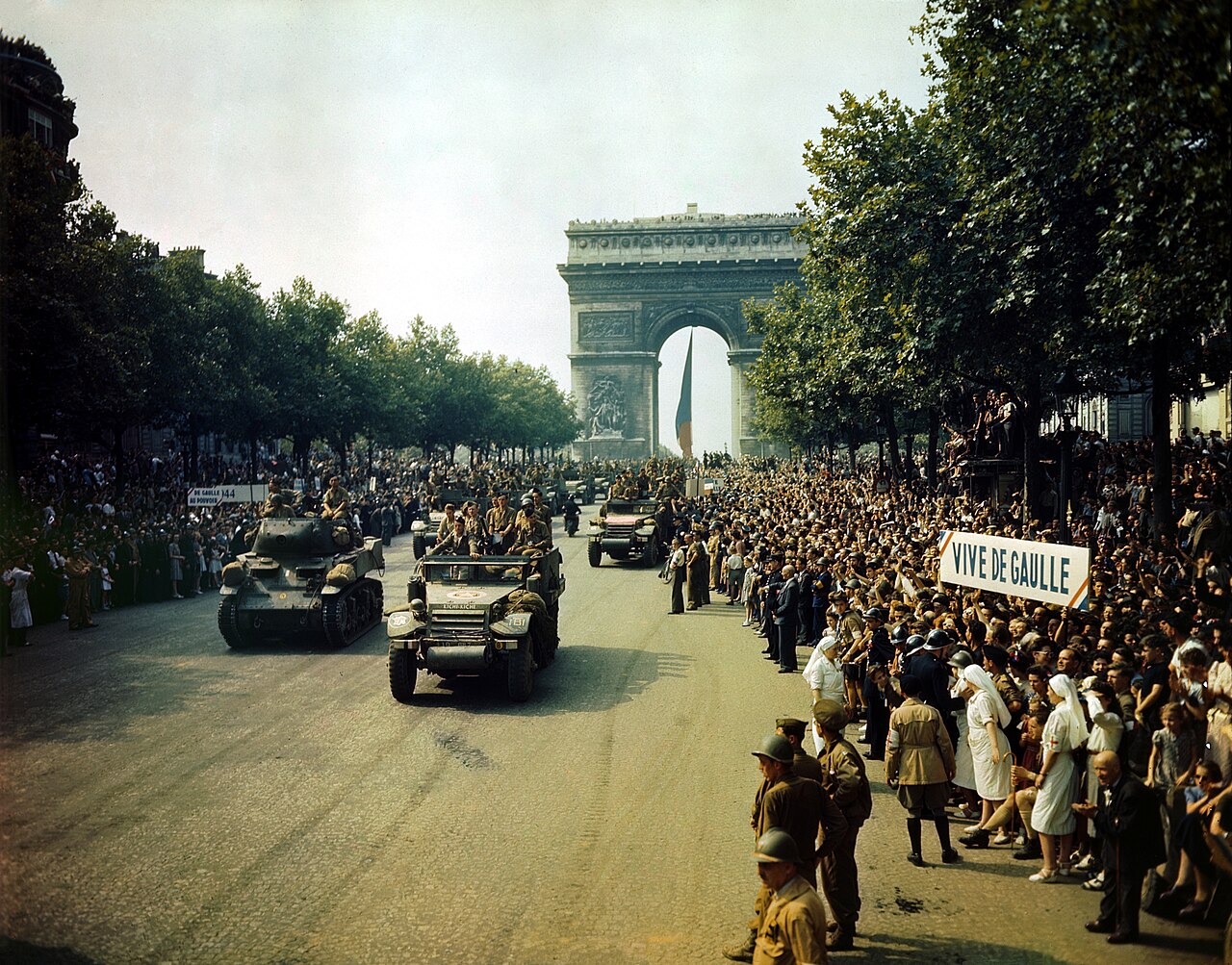
Paris rises in insurrection. The Free French 2nd Armored Division — given the honor by Eisenhower — leads the liberation of the capital. General Dietrich von Choltitz, the German commander, defies Hitler's direct order to burn the city to the ground and surrenders. De Gaulle marches down the Champs-Élysées through cheering millions while snipers fire from rooftops. Four years and fifty-seven days after German troops marched into Paris, France is free.
Paris Liberated
September 17 – 25, 1944
Operation Market Garden — A Bridge Too Far
Montgomery's ambitious plan: drop three airborne divisions (including the US 82nd and 101st) to capture bridges across Holland, then push British armor up a single highway to Arnhem and cross the Rhine — ending the war before Christmas. The 82nd and 101st succeed. At Arnhem, the British 1st Airborne is dropped too far from the bridge, supply drops are captured by the Germans, and a full Panzer Corps that intelligence had warned about destroys the force. Of 10,005 British paratroopers dropped, 1,485 are killed and 6,414 captured. The war will not end before Christmas.
Market Garden
December 16, 1944
Battle of the Bulge — Germany's Last Gamble
Hitler strips the Eastern Front and every reserve available to launch a massive counteroffensive through the Ardennes — the same route used in 1940. Three German armies, 250,000 men, punch through thin American lines in fog and freezing cold that grounds Allied aircraft. The 101st Airborne is surrounded at Bastogne. General McAuliffe's reply to the German surrender demand: "NUTS." Patton turns his entire Third Army ninety degrees north in 48 hours and breaks through to relieve Bastogne. When the fog lifts, Allied airpower annihilates the German columns. Germany has expended its last strategic reserve.
Battle of the Bulge
January – February 1945
The Rhine Approached — Germany Crumbles
Allied forces drive back across the ground lost during the Bulge and press toward the Rhine — the last great natural barrier into Germany's heartland. Soviet forces launch a massive winter offensive from the east, advancing 300 miles in three weeks. Germany is now fighting on all fronts with depleted forces, 16-year-old conscripts, and collapsing infrastructure. Allied strategic bombing has destroyed 70% of German oil production. The Luftwaffe can barely get aircraft off the ground. The end is coming.
Final Drive
March 7, 1945
Remagen Bridge — The Rhine Crossed
Sergeant Alex Drabik of the 9th Armored Division is the first American soldier to cross the Rhine River in force when his unit captures the Ludendorff Bridge at Remagen before German engineers can blow it. Eisenhower immediately exploits the crossing. Within 24 hours, 8,000 troops are across. Hitler orders four officers executed for failing to destroy the bridge. The American flag flies over the Rhine. The road to Berlin's Western approaches is open.
Rhine Crossed
April 11–15, 1945
The Camps — What It Was All For
American forces liberate Buchenwald concentration camp (April 11) and Bergen-Belsen (April 15). General Eisenhower personally visits Ohrdruf, a Buchenwald subcamp, on April 12. He orders all nearby towns to send citizens to see the dead. He cables Marshall: "I never dreamed that such cruelty, bestiality, and savagery could really exist in this world." He knows the world will need witnesses. He is right. Journalists and Congressional delegations are summoned immediately.
Holocaust · Liberation
April 16 – May 2, 1945
Battle of Berlin — The Soviet Final Assault
2.5 million Soviet troops assault Berlin. Eisenhower, deferring to the political agreement at Yalta, halts American forces at the Elbe River. The battle for Berlin costs the Red Army 81,000 dead and over 280,000 wounded in three weeks. German defenders — including teenage boys of the Hitler Youth and old men of the Volkssturm — fight street by street. The Reichstag is stormed on April 30. Soviet soldiers raise their flag over the ruins. In his bunker beneath the Chancellery, Adolf Hitler can hear the artillery.
Berlin Falls
April 30, 1945 — 15:30 HRS
Hitler Dead
Adolf Hitler, age 56, shoots himself in the right temple in the Führerbunker beneath the Reich Chancellery garden, Berlin. Eva Braun, whom he married the previous day, takes cyanide simultaneously. Their bodies are carried to the Chancellery garden, soaked in petrol, and burned — per Hitler's instructions, to prevent his corpse from being put on display as Mussolini's had been. Soviet troops reach the bunker within hours. The man who began the war that killed sixty million people is dead in a concrete hole beneath a burning city, his thousand-year Reich lasting twelve years, three months, and eight days.
Hitler Dead
May 7 – 8, 1945
V-E Day — Victory in Europe
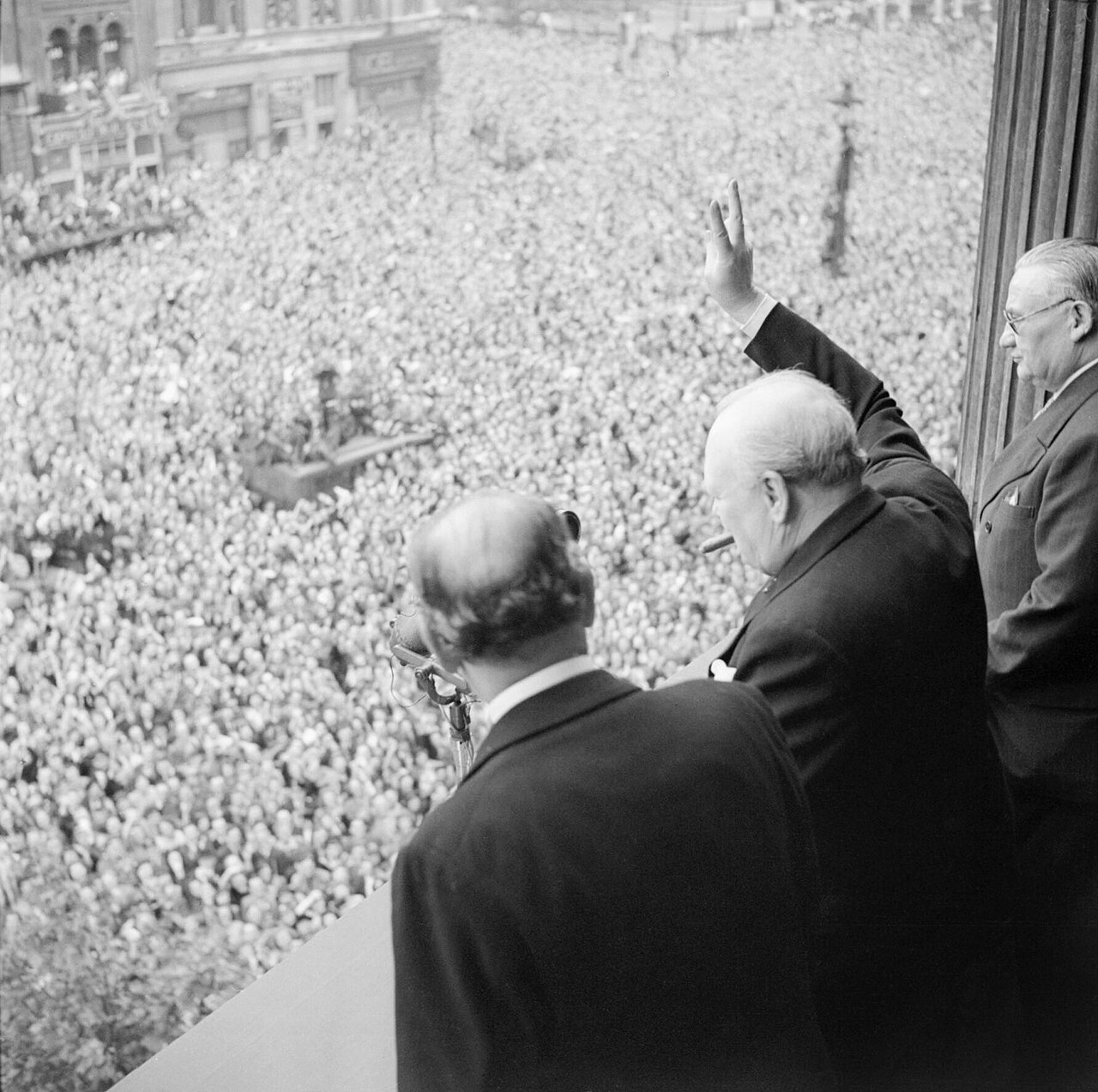
At 02:41 AM on May 7 in Reims, France, German General Alfred Jodl signs the unconditional surrender of all German armed forces. Effective 23:01 on May 8. Churchill broadcasts to the nation: "The evil-doers now lie prostrate before us." Millions fill the streets of London, Paris, New York, and Moscow. From the beaches of Normandy to the Führerbunker: 337 days. The war in Europe is over. The world that emerges from it — NATO, the United Nations, the Marshall Plan, the State of Israel, the nuclear age — is the world we still live in.
V-E Day
TOP SECRET — DECLASSIFIED 1996

THE GHOST ARMY

The 23rd Headquarters Special Troops — 1,100 men known as the "Ghost Army" — were perhaps the most unusual military unit America has ever fielded. Classified for fifty years after the war, their existence was unknown even to their families. They were artists, designers, sound engineers, and actors playing the role of an entire army corps.

Their mission: deceive the German Wehrmacht into believing large Allied formations were positioned where they were not — buying time, drawing reserves away from real operations, and protecting the flanks of advancing American divisions. Over 21 operations across France, Belgium, Luxembourg, and Germany, they impersonated entire divisions, corps headquarters, and armored columns. They may have saved 30,000 Allied lives.

In March 2022 — 77 years after the war ended — Congress awarded the Ghost Army the Congressional Gold Medal, the highest civilian honor the United States can bestow. Most of those who received it were over ninety years old.

Ghost Army inflatable tank
Inflatable M4 Sherman Tank · Ghost Army deception equipment
Ghost Army sound truck
Sonic Deception Half-Track
Ghost Army patch
23rd HQ Insignia
VIS

Visual Deception

600+ inflatable rubber tanks, artillery pieces, trucks, landing craft, and aircraft were deployed across fields and tree-lines. Inflated and positioned by hand — each Sherman weighing 90 pounds deflated — they could simulate an entire armored division from the air or ground. Camouflage was intentionally imperfect to ensure German reconnaissance aircraft would "discover" them.

Ghost Army deception
RAD

Radio Deception

Specially trained Signal Corps operators spent weeks studying the "fist" — the unique Morse code rhythm — of real operators in the divisions they were impersonating. They replicated traffic patterns, message frequency, call signs, and procedural errors of the units they replaced. German signals intelligence intercepted and plotted these phantom divisions on their maps. Real divisions could vanish silently; their ghost replacements kept transmitting in their name.

Signal Corps radio crew
SND

Sonic Deception

The 3132nd Signal Service Company operated M3 half-tracks fitted with powerful amplifiers and high-fidelity recordings — the most advanced audio equipment of the era. Recordings of tank column movements, bridge-building operations, infantry marching, and supply convoys could be broadcast up to 15 miles away in any direction. At night, they would "move" a phantom armored division into position — audible to German outposts across no man's land.

Sonic deception half-track
ART

The Artists

The Ghost Army recruited from art schools. Among those who served: future fashion designer Bill Blass, painter Ellsworth Kelly, illustrator Arthur Singer, and sculptor Sheppard Lowman. When not running deceptions they painted and sketched the French countryside. Their wartime artwork — produced in a unit that officially didn't exist — is today held by the Smithsonian and major museums. They documented a secret war in oil and watercolor.

WWII war art
PSY

Psychological Operations

Ghost Army men posed as officers from real divisions in cafes and public places near German observers, wearing the patches and insignia of the units they impersonated. Leaflets were air-dropped in coordination with their deceptions. Soldiers "carelessly" left false documents and unit markings for enemy intelligence to find. In one operation, they drove through French towns in broad daylight with placards identifying themselves as a division they weren't, knowing German agents were watching.

Allied propaganda leaflet
CGM

Recognition — 77 Years Late

The unit remained classified until 1996. Veterans could not speak of their service. Rick Beyer and Elizabeth Sayles documented the story in their 2012 PBS documentary and 2015 book The Ghost Army of World War II. In 2022, at a ceremony in Washington, the Congressional Gold Medal was presented to the last surviving members — most in their late nineties. It is the highest honor Congress can award civilians or military units. It came 77 years late.

Ghost Army Congressional Gold Medal

Major Ghost Army Operations

OperationDateLocationTechniqueDivision ImpersonatedEst. Lives Saved
ElephantSep 1944LuxembourgInflatable + Sonic6th Armored Div.3,000
BrestAug 1944BrittanyRadio + Dummy2nd Infantry Div.2,500
CasanovaFeb 1945Saar, GermanySonic + Visual94th Infantry Div.2,000
ElsenbornDec 1944Belgium (Bulge)Full Spectrum75th Infantry Div.1,500
ViersenMar 1945Rhine RiverFull Corps Simulation30th & 79th Divs.8,000
Operation Viersen — the Rhine crossing deception — is considered the Ghost Army's masterpiece and greatest success.
Omaha Beach aerial D-Day
OMAHA BEACH
June 6, 1944 · The Bloodiest American Landing of World War II

COMMANDING GENERALS

Dwight D. Eisenhower
★★★★★
Dwight D. Eisenhower
General of the Army
Supreme Allied Commander, SHAEF

Born Denison, Texas, 1890. West Point class of 1915 ("Class the Stars Fell On"). Entrusted by Roosevelt and Churchill with the most complex military operation in history. On June 5, after two postponements due to weather, Eisenhower gave the order to go. He visited the 101st Airborne the night before, shaking hands with men he feared might not return. He drafted a note accepting personal responsibility if the invasion failed. He destroyed it when it wasn't needed.

Distinguished Service Medal ×5 · Legion of Merit · French Croix de Guerre
Omar Bradley
★★★★
Omar N. Bradley
General
Commanding General, 1st U.S. Army

The "GI General" — revered by enlisted men for his accessibility and plainspoken manner. Bradley directed the American beach landings and on the morning of D-Day was aboard the command ship USS Augusta, watching Omaha through binoculars, considering whether to abandon the beach. He didn't. Later commanded the 12th Army Group — the largest American force ever assembled in combat. His memoirs, A Soldier's Story, remain essential reading.

Distinguished Service Cross · Legion of Merit · Bronze Star
George S. Patton
★★★★
George S. Patton
General
Army Group Patton (FUSAG) · Later 3rd Army

Perhaps the most valuable American officer on D-Day — by doing nothing. Allied intelligence knew German commanders believed Patton would lead any major invasion, so they made him the face of Operation Fortitude's fictional First United States Army Group (FUSAG), poised to strike Pas-de-Calais. Hitler held the 15th Army there for weeks after D-Day waiting for Patton's "real" invasion. Patton then commanded 3rd Army's legendary August breakout across France, covering 500 miles in two weeks.

Distinguished Service Cross · Distinguished Service Medal ×2 · Silver Star ×9 · Purple Heart
Bernard Montgomery
FM
Bernard L. Montgomery
Field Marshal
21st Army Group — All Allied Ground Forces

Commander of all Allied ground forces during the Normandy invasion. The hero of El Alamein — the battle that turned the tide in North Africa — Montgomery was supremely confident, frequently infuriating to his American counterparts, and tactically meticulous. He planned the ground operation for Overlord and directed the British and Canadian sectors. His battle for Caen — which took six weeks instead of one day — drew German armor away from the American breakout that ended the campaign.

Knight Grand Cross of the Bath · Distinguished Service Order ×3 · Légion d'honneur
Theodore Roosevelt Jr.
MOH
Theodore Roosevelt Jr.
Brigadier General
4th Infantry Division — Utah Beach

Son of President Theodore Roosevelt. At 56, the oldest American officer on any beach and the only general in the first wave. He landed with a cane — his arthritis was severe enough that he required a written request to his superiors for permission to go ashore with his men. When his wave landed on the wrong beach sector, Roosevelt walked the shoreline under fire assessing the situation, then made his famous decision. He died of a heart attack five weeks later, on July 12, 1944. He never learned he had been awarded the Medal of Honor.

Medal of Honor (posthumous) · Distinguished Service Cross · Silver Star ×3 · Purple Heart
Matthew Ridgway
★★
Matthew B. Ridgway
Major General
82nd Airborne Division — "All-American"

One of the finest combat commanders the United States produced in World War II. Ridgway parachuted with his men into Normandy on the night of June 5–6, landing in a hedgerow far from his intended drop zone. Over the following weeks he transformed the scattered 82nd into an effective fighting force under brutal conditions in the bocage. Later commanded XVIII Airborne Corps during Market Garden and the Ardennes, and became Army Chief of Staff. His career spanned from Normandy to Korea.

Distinguished Service Cross · Distinguished Service Medal ×4 · Silver Star ×2

FOR GOD
& COUNTRY

America entered World War II on December 8, 1941 — the day after Japan's attack on Pearl Harbor, which killed 2,403 Americans and wounded 1,178 more. Within four years, more than 16 million Americans served in uniform. From the deserts of North Africa to the jungles of the Pacific, from the skies over Germany to the beaches of Normandy, they carried the weight of a world that needed saving.

The United States mobilized its industrial capacity on a scale never seen before or since: 300,000 aircraft, 86,000 tanks, 8.5 million rifles, 40 billion rounds of ammunition. Women entered the workforce in historic numbers. African American soldiers, despite serving in a segregated military, fought and died for a freedom they were still denied at home. The Japanese American 442nd Regimental Combat Team — whose families were interned in camps — became the most decorated unit in US Army history.

Of the 405,399 Americans who died in World War II, 73,000 fell in Europe after D-Day. They are buried in cemeteries from Normandy to the Philippines, from Tunisia to the Netherlands. The white crosses stretch to every horizon.

"

Soldiers, Sailors and Airmen of the Allied Expeditionary Force! You are about to embark upon the Great Crusade, toward which we have striven these many months. The eyes of the world are upon you. The hopes and prayers of liberty-loving people everywhere march with you.

— General Dwight D. Eisenhower · Order of the Day · June 6, 1944
"

These are the boys of Pointe du Hoc. These are the men who took the cliffs. These are the champions who helped free a continent. These are the heroes who helped end a war.

— President Ronald Reagan · 40th Anniversary of D-Day · June 6, 1984

D-Day Casualties by Nation

NationKilledWoundedMissing / POWTotal Est.
American2,5011,5001,100~5,100
British1,641900600~3,141
Canadian35957447~980
GermanEstimated 4,000–9,000 (records incomplete)~4,000–9,000

Sources: US Army Center of Military History · Commonwealth War Graves Commission · Veterans Affairs Canada · German Federal Archives. German figures are estimates; systematic record-keeping broke down under the assault.

Medal of Honor — Normandy Campaign

The Medal of Honor is the United States' highest military decoration, awarded by Congress in the name of the President. The following men received it for actions during the Normandy campaign, June 6–July 1944. Several received it posthumously.

MOH
Theodore Roosevelt Jr.
4th Infantry · Utah Beach

Led first wave ashore under fire, reorganized mislanded troops and personally directed them inland. Died July 12, 1944.

MOH
Jimmie Monteith Jr.
1st Division · Omaha Beach

Led men off the beach, guided two tanks through a minefield, organized assault on pillboxes. KIA June 6.

MOH
Carlton Barrett
1st Division · Omaha Beach

Made multiple trips into neck-deep water under fire to rescue wounded and guide landing craft to shore.

MOH
Walter Ehlers
18th Infantry · Goville

On two consecutive days, led attacks against entrenched German positions, destroying multiple machine gun nests while wounded.

MOH
John J. Pinder Jr.
16th Infantry · Omaha Beach

Made three trips into chest-deep surf under fire to retrieve radio equipment. Twice wounded, continued working until killed. KIA June 6.

MOH
Frank D. Peregory
29th Division · Grandcamp

Single-handedly assaulted a fortified trench system, killing 8 and capturing 35 enemy soldiers. KIA June 14.

MOH
Arthur F. DeFranzo
1st Division · Vaubadon

Twice wounded, continued leading his men against a German strongpoint, destroying a machine gun nest. KIA June 10.

MOH
Charles DeGlopper
82nd Airborne · La Fière

Stood in the open, drawing enemy fire alone to allow his patrol to escape the La Fière causeway. KIA June 9.

THE ADVANCE

From the Normandy beachhead to the fall of Berlin. The Western Allies drive east from the beaches while the Soviet Red Army pushes west, squeezing German-held Europe until it collapses. Press play, drag the slider, or jump to any milestone to move through the eleven months that ended the Third Reich.

6 June 1944
D-Day. Allied forces land at Normandy while Axis Germany holds nearly all of Western Europe.
Axis-held Western Allies Soviet advance Liberated
Normandy American Cemetery
NORMANDY AMERICAN CEMETERY
9,387 Americans rest here · Colleville-sur-Mer, France

THEY CAME NOT AS
CONQUERORS
BUT AS LIBERATORS

On the seventy-ninth anniversary of D-Day, fewer than 200 American veterans of Operation Overlord were believed to still be alive. Within a generation, the last living witnesses will be gone. What remains are the white crosses on the Norman cliffs, the bomb craters at Pointe du Hoc, the names carved in stone at Colleville-sur-Mer, and the words they left behind.

"Every man who set foot on Omaha Beach that day was a hero."

— General Omar N. Bradley
★ ★ ★ ★ ★ ★ ★ ★ ★ ★ ★ ★ ★
IN MEMORY OF ALL WHO SERVED AND ALL WHO FELL · JUNE 6, 1944